Friday, 13 October 2017

Sunday, 24 September 2017
Thursday, 21 September 2017
Sunday, 13 August 2017
Iphone Loot Offer 6 32gb gold
Hi,
This Independence day sale get Iphone 6 Gold 32Gb in 26999 from trusted website Amazon.in.
You can click below to visit there page.
Thanks.
Apple iPhone 6 (Gold, 32GB)This Independence day sale get Iphone 6 Gold 32Gb in 26999 from trusted website Amazon.in.
You can click below to visit there page.
Thanks.

Saturday, 19 September 2015
The Local Group as a Time Machine: Studying the High-Redshift Universe with Nearby Galaxies
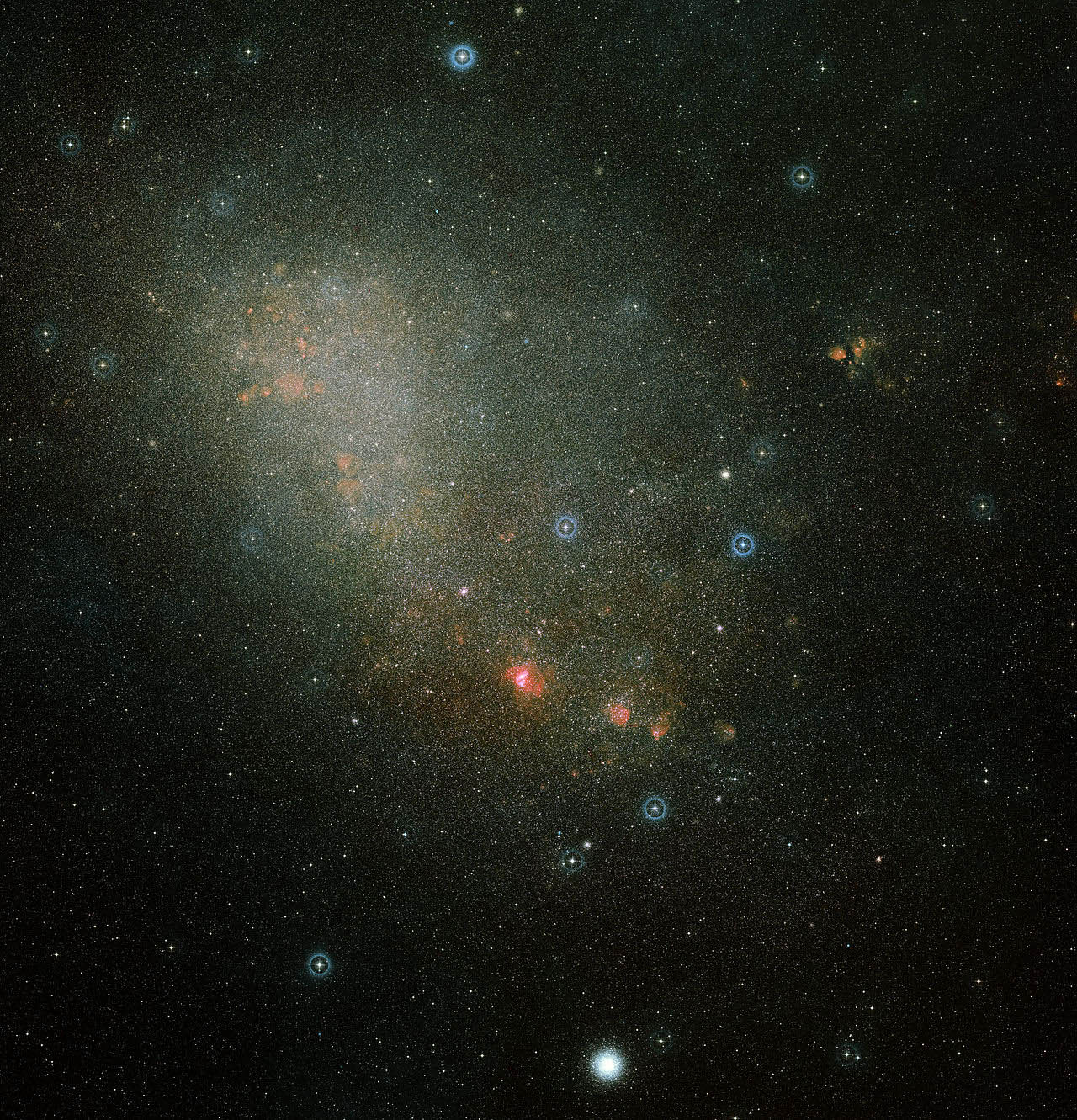
The
Small Magellanic Cloud, a companion to the Milky Way galaxy and a
member of our Local Group of galaxies. The field of view is slightly
larger than 3.5 x 3.6 degrees.
Most galaxies lie in clusters, groupings of several to many thousands of galaxies. Our Milky Way galaxy itself is a member of the “Local Group,” a band of about fifty galaxies whose other large member is the Andromeda Galaxy about 2.3 million light-years away. The closest large cluster of galaxies to us is the Virgo Cluster, about 50 million light-years away, with about 2000 members. Astronomers are peering back into cosmic history, examining distant galaxies and trying to reconstruct the evolution of the universe, but distant galaxies are faint and hard to detect. Analyzing the evolution of clusters of galaxies offers a way to overcome this limitation.
About 380,000 years after the big bang, the nuclei of hydrogen atoms combined with free electrons to form neutral gas, beginning the so-called Dark Ages (“dark” because cold neutral gas does not radiate much). About four hundred million years later this gas began to be re-ionized by ultraviolet radiation from a newly born cosmic denizen: stars. There is a major gap in our understanding of this period, however: There did not seem to have been enough bright galaxies and stars back then to have done the job, at least according to astronomers who model the epoch of re-ionization. They conclude that faint galaxies, those 100-1000 times below the detection limits of current observatories, must have been necessary contributors. NASA’s soon-to-be-launched James Webb Space Telescope (JWST) has as one of its primary goals the detection of these hypothesized, faint galaxies.
CfA astronomers Benjamin Johnson and Charlie Conroy and their collaborators argue that even JWST is unlikely to detect the faintest and most numerous of these sources. Instead, they propose an alternative way to solve the problem of the missing ultraviolet: they use the Local Group of galaxies to learn about the faintest galaxies at the epoch of reionization. The scientists applied models of stellar evolution to extrapolate the current galaxies’ properties back to the epoch of re-ionization from its end time about one billion years after the big bang to times a few hundred million years earlier. The astronomers were able to show that many of the faintest galaxies in the Local Group today were at one time nearly as bright as the most distant galaxies currently being detected, and that the Milky Way’s two major dwarf galaxy companions, the Large and Small Magellanic Clouds, were also substantially more luminous back then. The team reports that even the small irregular galaxies in the Local Group must have been significant contributors to cosmic re-ionization back then, although even so they were so faint that JWST would not be able to see them.
Yale Scientists Solve the Problem of Sea Ice Thickness Distribution

Using molecular concepts and treating the ice floes of the frozen seas like colliding molecules in a fluid or gas, researchers at Yale University have answered a 40-year-old question about Arctic ice thickness.
Although today’s highly precise satellites do a fine job of measuring the area of sea ice, measuring the volume has always been a tricky business. The volume is reflected through the distribution of sea ice thickness — which is subject to a number of complex processes, such as growth, melting, ridging, rafting, and the formation of open water.
For decades, scientists have been guided by a 1975 theory (by Thorndike et al.) that could not be completely tested, due to the unwieldy nature of sea ice thickness distribution. The theory relied upon a term that could not be related to the others, which represented the mechanical redistribution of ice thickness. As a result, the complete theory could not be mathematically tested.
Enter Yale professor John Wettlaufer, inspired by the staff and students at the Geophysical Fluid Dynamics Summer Study Program at the Woods Hole Oceanographic Institution, in Massachusetts. Over the course of the summer, Wettlaufer and Yale graduate student Srikanth Toppaladoddi developed and articulated a new way of thinking about the space-time evolution of sea ice thickness.
The resulting paper will appear in the September 17 edition of the journal Physical Review Letters.
“The Arctic is a bellwether of the global climate, which is our focus. What we have done in our paper is to translate concepts used in the microscopic world into terms appropriate to this problem essential to climate,” said Wettlaufer, who is the A.M. Bateman Professor of Geophysics, Mathematics and Physics at Yale.
Wettlaufer and co-author Toppaladoddi recast the old theory into an equation similar to a Fokker-Planck equation, a partial differential equation used in statistical mechanics to predict the probability of finding microscopic particles in a given position under the influence of random forces. By doing this, the equation could capture the dynamic and thermodynamic forces at work within polar sea ice.
“We transformed the intransigent term into something tractable and — poof — solved it,” Wettlaufer said.
The researchers said their equation opens up the study of this aspect of climate science to a variety of methods normally used in nonequilibrium statistical mechanics.
Source: Jim Shelton, Yale University
Nexus 6 VS Moto X 2015
Google’s Nexus line has been through many
guises during the past several years with the likes of HTC, Samsung and
finally LG and Motorola undertaking OEM duties for the Big G. But
perhaps the two most notable handsets of all were the Nexus 4 and the
Nexus 5 –– both were hugely disruptive devices and both really did put
the Nexus brand on the map.
A lot of people thought LG were on track to do a hat trick and secure a commission to build the Nexus 6. But –– for whatever reasons, and there are a few, as you can see in the paragraph below –– this didn’t happen. Instead, it was Motorola who was tasked with the privilege of building 2014’s Nexus 6. And 2014’s Nexus is a very different beast to 2012 and 2013’s Nexus having a higher price tag, improved specs across the board and a brand new gargantuan chassis for its massive 6in QHD display.
Evan Blass, in his column for KYM, believes the Nexus 6 we now know and love started life out as another handset entirely – the Moto S. The story goes that, after something of a crisis within Google, one featuring LG, Project Silver and the public reaction to Google killing off its Nexus programme, the decision was eventually made to pass the baton to Moto. And the rest, as they say, is history.
And that was just fine by us. Moto has been pumping out fine hardware for the past year or so, and the Nexus 6 is no exception. If the above scenario is true, then the Nexus 6 is basically just a bigger version of the Moto X with similar specs, hardware and performance. But is this the case? Lets examine both handsets in order to find out.
Here’s how the Moto X (2014) and Nexus 6 compare on paper.
QHD –– whether you care or not –– is the new benchmark screen display in the Android space. In a world where Keeping up with the Jones’ is the name of the game, stuff changes rapidly and in this context 1080p displays appear to be going the way of BlackBerry with more and more handset manufacturers producing flagships with QHD setups. Samsung, LG, Google are just the first but there will be plenty more as we progress through 2015.
 Both displays offer a great pixel density whilst viewing angles and
contrast are excellent. The larger display will suit some whilst the
Moto X will suit others. The Nexus 6 comes in a lot larger than the Moto
X to house the display and could be unwieldy in smaller hands. It also
makes the phone quite a bit heavier as well.
Both displays offer a great pixel density whilst viewing angles and
contrast are excellent. The larger display will suit some whilst the
Moto X will suit others. The Nexus 6 comes in a lot larger than the Moto
X to house the display and could be unwieldy in smaller hands. It also
makes the phone quite a bit heavier as well.
An ultra-thin bezel around the display is similar in both handsets as is the metal surrounding on both. The Nexus 6 comes with a plastic backing and is available in either Midnight Blue or Cloud White.
 A big selling point of the Moto X (2014) comes in the form of the
Moto Maker. It’s a website that allows you to customise your own Moto X
including the choice of front panel colour – either black or white – and
a much wider range of back panels including wood, leather and coloured
plastics.
A big selling point of the Moto X (2014) comes in the form of the
Moto Maker. It’s a website that allows you to customise your own Moto X
including the choice of front panel colour – either black or white – and
a much wider range of back panels including wood, leather and coloured
plastics.
The type of material you choose can drive the price up but it means you can get the exact design you’ve wanted. You can even change the accent colour on the back camera ring.
 Storage options differ a little as the Nexus 6 has either 32GB or
64GB options. The Moto X only offers 16GB or 32GB and neither device
offers microSD support.
Storage options differ a little as the Nexus 6 has either 32GB or
64GB options. The Moto X only offers 16GB or 32GB and neither device
offers microSD support.
The Nexus 6 comes in a little higher up the food chain with a Snapdragon 805 quad-core processor clocked at 2.7GHz alongside 3GB of RAM. That means Nexus 6 beats the Moto X in terms of raw power but only marginally. It isn’t a big jump as both are very similar and won’t offer that much difference in performance.
 In terms of software both run Android Lollipop, so there's not much
to really separate them here. The Moto X runs Android exactly how Google
intended –– i.e. with no custom overlay. There are a couple of Motorola
specific apps but nothing like the amount on say a Samsung device.
In terms of software both run Android Lollipop, so there's not much
to really separate them here. The Moto X runs Android exactly how Google
intended –– i.e. with no custom overlay. There are a couple of Motorola
specific apps but nothing like the amount on say a Samsung device.
Google’s Nexus 6 also runs a stock version of the software but this time it’s running the more up to date Android 5.0 Lollipop. It is the first handset to do so and it means you get the brand new Material Design UI. Google has overhauled the look of the entire UI and now offers a brand new design with a much flatter and more stylish look than that on KitKat. Be sure to check out our Android Lolliopop Review for all the details.
The Nexus 6 has added features of dual-recording (where you can use both the selfie and primary cameras at once) and optical image stabilization.
 Each can also record video in 4K @ 30fps and both have 2MP front
facing selfie snappers. Aperture wise the cameras differ, the Nexus 6
comes with an F2.0 aperture whilst the Moto X has a slightly larger
number of F2.2 - lower numbers are better though.
Each can also record video in 4K @ 30fps and both have 2MP front
facing selfie snappers. Aperture wise the cameras differ, the Nexus 6
comes with an F2.0 aperture whilst the Moto X has a slightly larger
number of F2.2 - lower numbers are better though.
The optical image stabilization on the Nexus 6 is a big selling point and will make a difference to your photo snapping abilities.
In our review we put the Moto X through its paces in what we call the Django Test. Essentially we turn the brightness right up, make sure connectivity is all on and run the 2hr 45min film Django Unchained and see what battery is left over afterwards. The Moto X came out the other side with 69%, a respectable score compared to other flagship devices this year.
The Nexus 6, with its HUGE battery, didn’t exactly live up to expectations during our two-week testing period. In the Django Test is just about scraped 60%. At best the Nexus 6’s battery could be described as average, giving you about 4 hours screen time tops in between charges –– not very much given just how big its battery is. A lot of this is to do with its QHD display, however, as more pixels, generally, means more battery problems (even with a 3220mAh unit in the back).
The iPhone 6 Plus, for instance, is around the same size as the Nexus 6 but it uses a smaller battery (well under 3000mAh) and a 1080p display. BUT it manages around 30% better performance than the Nexus 6, easily handling two day’s of medium usage from a single charge. We expected quite a bit from the Nexus in this regard because, like a lot of people, battery performance was one of our only complaints about the Nexus 5.
Here's an extract from our Nexus 6 Review:
"The Nexus 6 isn’t a bad handset, though: it’s just disappointing to a dyed-in-the-wool Nexus user like myself. I had high hopes for this handset –– even more so when I saw the specs and that Motorola was in charge of designing and building it. But after testing I was left with a bitter taste in my mouth. Google seems to have lost sight of what made the Nexus 4 and Nexus 5 special –– what separated them from every other generic Android handset on the market. It’s sort of like when a band you really like gets a bit of attention and then, in a bid to appeal to even more people, augments it sound, tries to do too much and ends up with an album that lacks a lot of what made them good in the first place... sort of like the Kings of Leon."
For more Updates www.beczotricks.com
A lot of people thought LG were on track to do a hat trick and secure a commission to build the Nexus 6. But –– for whatever reasons, and there are a few, as you can see in the paragraph below –– this didn’t happen. Instead, it was Motorola who was tasked with the privilege of building 2014’s Nexus 6. And 2014’s Nexus is a very different beast to 2012 and 2013’s Nexus having a higher price tag, improved specs across the board and a brand new gargantuan chassis for its massive 6in QHD display.
Evan Blass, in his column for KYM, believes the Nexus 6 we now know and love started life out as another handset entirely – the Moto S. The story goes that, after something of a crisis within Google, one featuring LG, Project Silver and the public reaction to Google killing off its Nexus programme, the decision was eventually made to pass the baton to Moto. And the rest, as they say, is history.
And that was just fine by us. Moto has been pumping out fine hardware for the past year or so, and the Nexus 6 is no exception. If the above scenario is true, then the Nexus 6 is basically just a bigger version of the Moto X with similar specs, hardware and performance. But is this the case? Lets examine both handsets in order to find out.
Here’s how the Moto X (2014) and Nexus 6 compare on paper.
| Device | Motorola Moto X (2014) | Motorola Nexus 6 |
| Dimensions | 140.8 x 72.4 x 10mm, 144g | 159.3 x 83 x 10.1mm , 184g |
| Display | 5.2in AMOLED, 1920 x 1080 pixels, 424ppi | 5.96in AMOLED, 1440 x 2560 pixels, 493ppi |
| Camera | 13-megapixel, dual-LED flash, 2160p video | 13-megapixel, dual-LED flash, 2160p video |
| Storage | 16GB, 32GB | 32GB, 64GB |
| Processor, RAM, Graphics | 2.5GHz Qualcomm Snapdragon 801 quad-core Krait 400 (MSM8974AC) 2GB RAM, Adreno 330 GPU | 2.7GHz Qualcomm Snapdragon 805 quad-core Krait 450, 3GB RAM, Adreno 420 GPU |
| Operating System, | Android 4.4 KitKat | Android 5.0 Lollipop |
| UI | N/A | N/A |
| Connectivity | microUSB, Bluetooth, NFC, dual-band Wi-Fi (Hotspot),DLNA,4G,GPS | microUSB, Bluetooth, NFC, dual-band Wi-Fi (Hotspot),DLNA,4G,GPS |
| Battery | 2,300mAh | 3,220mAh |
Nexus 6 vs Moto X (2014): Design & Display
Both the Nexus 6 and the Moto X (2014) share a lot of the same design language. When comparing photographs of the devices side by side it is difficult to tell which is which. The biggest difference comes in terms of size. The Moto X is the smaller device with a 5.2in display – it is still quite large in the hand and offers full HD 1080p at 424ppi. The Nexus 6 is a phablet device and comes with a 5.96in – let’s say 6in – AMOLED display offering full 2K resolution at 493ppi.QHD –– whether you care or not –– is the new benchmark screen display in the Android space. In a world where Keeping up with the Jones’ is the name of the game, stuff changes rapidly and in this context 1080p displays appear to be going the way of BlackBerry with more and more handset manufacturers producing flagships with QHD setups. Samsung, LG, Google are just the first but there will be plenty more as we progress through 2015.

An ultra-thin bezel around the display is similar in both handsets as is the metal surrounding on both. The Nexus 6 comes with a plastic backing and is available in either Midnight Blue or Cloud White.

The type of material you choose can drive the price up but it means you can get the exact design you’ve wanted. You can even change the accent colour on the back camera ring.
Nexus 6 vs Moto X (2014): Hardware, Storage & Connectivity
Motorola’s connectivity options are remarkably similar on both devices. Each has microUSB for data transfer and charging as well as Bluetooth NFC, dual-band Wi-Fi (Hotspot), DLNA, 4G and GPS.
Nexus 6 vs Moto X (2014): Processor, Software & Performance
Under the hood both handsets once again look quite similar. The Moto X runs a Qualcomm Snapdragon 801 quad-core chipset clocked at 2.5GHz. It runs alongside 2GB of RAM.The Nexus 6 comes in a little higher up the food chain with a Snapdragon 805 quad-core processor clocked at 2.7GHz alongside 3GB of RAM. That means Nexus 6 beats the Moto X in terms of raw power but only marginally. It isn’t a big jump as both are very similar and won’t offer that much difference in performance.

Google’s Nexus 6 also runs a stock version of the software but this time it’s running the more up to date Android 5.0 Lollipop. It is the first handset to do so and it means you get the brand new Material Design UI. Google has overhauled the look of the entire UI and now offers a brand new design with a much flatter and more stylish look than that on KitKat. Be sure to check out our Android Lolliopop Review for all the details.
Nexus 6 vs Moto X (2014): Camera
Both the Nexus 6 and Moto X have a 13MP sensor on the back offering a pixel resolution of 4128 x 3096 and a dual-LED flash. Each also offers Geo-tagging, touch focus, face detection, panorama and HDR.The Nexus 6 has added features of dual-recording (where you can use both the selfie and primary cameras at once) and optical image stabilization.

The optical image stabilization on the Nexus 6 is a big selling point and will make a difference to your photo snapping abilities.
Nexus 6 vs Moto X (2014): Battery
On paper the Moto X comes with a 2,300mAh battery whilst the Nexus 6 comes with a much heftier 3,220mAh power supply. That is quite a big difference but remember the Nexus 6 also has to power quite a bit more screen real estate.In our review we put the Moto X through its paces in what we call the Django Test. Essentially we turn the brightness right up, make sure connectivity is all on and run the 2hr 45min film Django Unchained and see what battery is left over afterwards. The Moto X came out the other side with 69%, a respectable score compared to other flagship devices this year.
The Nexus 6, with its HUGE battery, didn’t exactly live up to expectations during our two-week testing period. In the Django Test is just about scraped 60%. At best the Nexus 6’s battery could be described as average, giving you about 4 hours screen time tops in between charges –– not very much given just how big its battery is. A lot of this is to do with its QHD display, however, as more pixels, generally, means more battery problems (even with a 3220mAh unit in the back).
The iPhone 6 Plus, for instance, is around the same size as the Nexus 6 but it uses a smaller battery (well under 3000mAh) and a 1080p display. BUT it manages around 30% better performance than the Nexus 6, easily handling two day’s of medium usage from a single charge. We expected quite a bit from the Nexus in this regard because, like a lot of people, battery performance was one of our only complaints about the Nexus 5.
Here's an extract from our Nexus 6 Review:
"The Nexus 6 isn’t a bad handset, though: it’s just disappointing to a dyed-in-the-wool Nexus user like myself. I had high hopes for this handset –– even more so when I saw the specs and that Motorola was in charge of designing and building it. But after testing I was left with a bitter taste in my mouth. Google seems to have lost sight of what made the Nexus 4 and Nexus 5 special –– what separated them from every other generic Android handset on the market. It’s sort of like when a band you really like gets a bit of attention and then, in a bid to appeal to even more people, augments it sound, tries to do too much and ends up with an album that lacks a lot of what made them good in the first place... sort of like the Kings of Leon."
For more Updates www.beczotricks.com
Subscribe to:
Posts (Atom)